General News
5 July, 2025
VETERANS' VOICES: Australia's first WWI troop convoy
The first convoy of the Australia Imperial Force (AIF) set sail for Europe from Albany in Western Australia on November 1, 1914.
The convoy consisted of 38 transport ships (as well as a further 10 from New Zealand) escorted by seven warships.
While in transit, the troops were ordered to disembark in Egypt where they formed into the Australian and New Zealand Army Corps
The Australian Government formed the AIF within two weeks of the war starting.
Thousands of men volunteered to enlist in the AIF and received basic military training in their home state.
More than 21,000 men, as well as medical staff, horses and supplies, sailed from Australia in that first convoy of ships.
They were destined for Europe but events unfolded as they sailed that would change their fate.
Setting off for Europe
The first contingent of soldiers destined for the war in Europe departed from Albany as its final Australian port.
The men sailed in a convoy of 38 Australian transports or troopships (36 from Albany and two from Fremantle) and 10 New Zealand transports.
The ships were mostly converted merchant ships from ports around Australia and New Zealand.
The merchant sailors who crewed the ships were unfamiliar with wartime conventions such as sailing in formation and darkening night lights for added safety.
Precious cargo on board the troopships included about:
- 21,500 Australians
- 8500 New Zealanders
- 12,000 horses from both countries
- medical and military equipment and supplies.
A German warship, SMS Emden, was a potential threat in the Indian Ocean.
The British Admiralty ordered an escort of four warships to protect the convoy:
- HMAS Melbourne
- HMAS Sydney
- HMS Minotaur
- HIJMS Ibuki (a Japanese battle cruiser).
Sydney and Melbourne had recently helped to capture German New Guinea.
On board the ships, the 1st Division of the AIF included:
- engineers
- artillery
- field ambulances
- infantry
- light horse
- medical officers
- nurses.
Private Archibald Barwick of the AIF 1st Battalion, who served with his unit for the whole war and returned home in 1919, wrote: “... All that day we watched the Australian coast fading away, till darkness shut it out, and when we got up in the morning we were out of sight of land, and nothing but the calm blue sea all around us, like a sheet of shimmering glass, and at last we felt we were fairly on the way to England.”
Destruction of SMS Emden
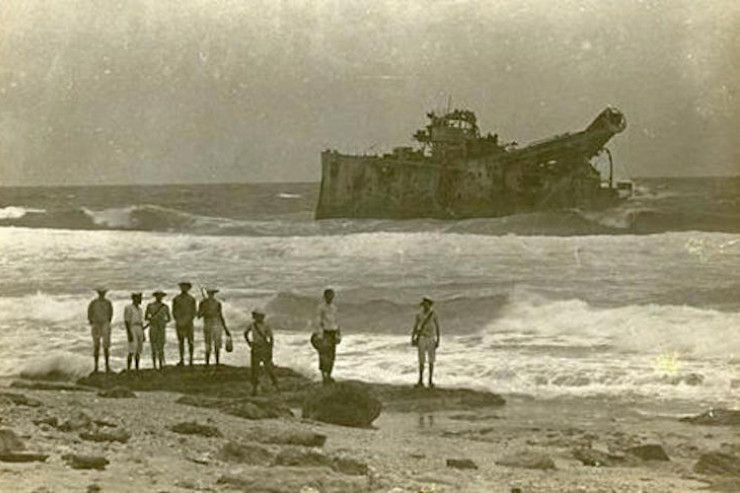
A landing party of 50 Germans from SMS Emden had destroyed the wireless station on Direction Island, now part of the Cocos (Keeling) Islands.
The subsequent Battle of Cocos between HMAS Sydney and SMS Emden was an exciting diversion for soldiers in the convoy.
By the end of the battle:
- four of Sydney's crew had died and 12 were wounded
- 134 of Emden's crew had died, 65 were wounded and 157 had been captured during the attack by Sydney.
The German landing party escaped in a sailing ship commandeered from the island.
The men eventually reached Germany, via Sumatra, Arabia and Constantinople (now Istanbul).
Some of Sydney's crew checked the situation on the island and reported a gruesome sight of blood, guts, flesh and uniforms.
The men returned the next morning to help the wounded survivors.
Emden was well known in the British Empire so its sinking was widely reported in newspapers around the world.
The Royal Australian Navy enjoyed positive publicity, and Australians felt proud of their new navy.
The first convoy proceeded without further incident to Colombo and then to Egypt's Mediterranean coast.
The ships docked in Alexandria on December 3 1914.
Diverted to Egypt
The men and women in the first convoy thought they were going to England and then across the English Channel to France.
However, the ships were ordered to disembark the force in Egypt.
The soldiers and the horses were transported to British military camps around Cairo.
Of the Australians and New Zealanders who trained in the desert beneath the pyramids, sent there to meet the threat which the Ottoman Empire (modern-day Turkey) posed to British interests in the Middle East and to the Suez Canal, few had heard of a place called 'Gallipoli'.
Between December 1914 and March 1915, a new situation developed in the war.
After four and a half months of training near Cairo, the Australians departed by ship for the Gallipoli Peninsula with troops from New Zealand Britain and France.
Most of these men and nurses were destined to serve in the Gallipoli campaign against the Ottoman army.
In all, approximately 50,000 Australians and 16,000–17,000 New Zealanders saw service at Gallipoli throughout 1915.
With thanks: Sally Bertram, RSL Military History Library. Contact Sally at sj.bertram@hotmail.com or call 0409 351 940.