General News
24 October, 2025
Donald deal groundwork for Donald Project
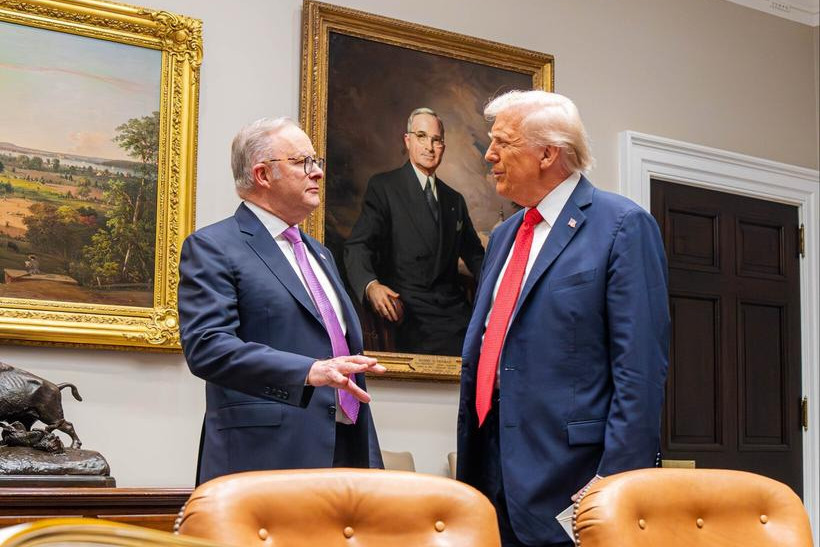
WHILE the international agreement signed off in Washington DC between US President Donald Trump and Australian Prime Minister, Anthony Albanese worth up to $US8.5 billion, was limited on the finer details on the supply of rare earth minerals to the USA, the significance of this connecting broadly to a major Wimmera mining project green lit in the same week by the government was not be lost on many local farmers and residents.
On Monday, it was announced the Federal Government had just granted Major Project Status to the $520 million Donald Rare Earth and Mineral Sands Project through the Major Projects Facilitation Agency.
Earlier this year, the project also received approval from Resources Victoria, paving the way for the commencement of construction activities to prepare for mining.
The project will feature a total mineral resource of 1.81 billion tonnes with a planned 58+ year mine life over two phases.
The site will operate 24 hours every day of the year, with mine products transported to the Port of Portland for export overseas.
As one of the largest rare earth resource mines outside China, once it starts operating – slated to be as early as 2027 – the Donald Project, located between Minyip and Donald, has been promoted to become a world-class source of critical minerals such as zirconium and titanium, and rare earth elements including neodymium and praseodymium.
These have many applications in a long list of modern medical, military, industrial and high-end consumer products.
The mine is a joint venture between recently redomiciled from Hong Kong to Australia, Astron Corporation, and the United States uranium giant Energy Fuels, with processing of the rare earth concentrate planned to be at the latter’s White Mesa Mill in Utah.
The mine fits into the White House's long-term strategy to challenge China’s decades-long dominance of the critical minerals supply market, with China providing about 60-70 per cent of global production and handling around 85-90 per cent of rare earth refining and separation.
In a statement, Astron said the designation of Major Project Status recognised “the project's national significance and its potential contribution to economic growth, employment, and regional Australia”.
Astron Limited managing director, Tiger Brown, expressed his delight at the announcement.
“This support will streamline our engagement with federal agencies and accelerate our pathway to development,” he said.
“The Donald Project will create significant employment opportunities and deliver long-term economic benefits to the Wimmera region of Victoria. At the same time, it will strengthen Australia's sovereign capability in critical minerals and advanced technology supply chains."
There was additional news for the project with the announcement it had received a non-binding and conditional Letter of Support from Export Finance Australia for up to A$80 million in respect of senior debt project financing for its development.
Astron and Energy Fuels said the letter represented a key milestone in progressing the project’s debt financing plan and complemented their broader funding initiatives, including the Donald Project Joint Venture equity funding.
The heavy rare earths expected to be produced from Donald Phase 1 would satisfy approximately one-third of US demand for dysprosium and a quarter of demand for terbium, both important to advanced manufacturing.
Energy Fuels chief executive, Mark Chalmers, said the letter was “a strong vote of confidence” for the project and the “exceptional concentrations” of rare earth oxides made it a valuable part of supporting global critical minerals supply chains.
“This is a key additional step in our financing pathway and reflects our ongoing progress toward delivering one of Australia’s most important rare earth projects,” he said.
But for some local farmers, the announcements only further entrenched feelings that those outside agricultural communities don’t take their businesses seriously and cemented their resolve to speak up.
The Victorian Farmers Federation released a statement expressing concerns about the government’s dialogue with the US and needing to “ensure farmers and regional communities are not ignored in the rush to secure rare earth minerals”, highlighting potential impacts on their farms, communities and the natural environment.
“This can’t be all one-way traffic where farmers and local communities are pushed aside, water is diverted, and irreplaceable farmland is damaged forever,” VFF president Brett Hosking said.
“The community feels they don’t have a voice in the process, which is to the detriment of the projects and good planning. These are the people who know the land, community and environment better than anyone else.
“Some of the land earmarked for these mines is prime, irreplaceable farmland. Once it’s gone, it’s gone forever, and we must protect it before it’s too late.
“The government and these companies must listen to the community and genuinely consult with those set to be impacted, otherwise we’ll continue to see massive community opposition right across regional Victoria.”
Mr Hosking added the VFF urged governments to strengthen consultation requirements, provide transparent information on environmental impacts, and ensure that agricultural productivity and water resources are not put at risk by mining operations.
“This can’t be a free-for-all driven by global politics,” he said.
“We need a balanced approach that respects property rights, safeguards regional industries, and delivers lasting benefits to the communities that host these projects.”
“We might be a small fish up against these huge mining companies driven by global superpower tensions, but this land and these farmers matter and help provide food for millions.”
“We’re asking for genuine consultation and a voice to help safeguard generational farming families.”
Minyip farmer, Ryan Milgate, took to social media on X, posting a video which he said would “give a bit of context” to the situation.
Standing next to the proposed site, he said, “We've seen a lot of talk from between Donald Trump and Albo about critical minerals, and I thought I'd just show you exactly what it means for the residents out east of Minyip.”
“Right behind me here is where … the Donald project mine will be. I'll be literally pointing at the separation plant right there where that beautiful barley crop is.”
Detailing where his house was and where lights would be of the 24/7 operation, he added, sardonically, “I can see those lights from home now, so I'll have a beautiful view out of my kitchen window for the next 30 (or) 40, years of a mine.”
Mr Milgate bent down to grab a handful of soil to explain why the land had so much value.
“It's beautiful black soil, (and) flat, open country, really productive cropping land,” he said.
“A lot of the Australian cropping belt would give a lot for soils like this, and we're just going to dig them up for 2.75 per cent royalties.”
Speaking to the Wimmera Mail Times, Mr Milgate said he didn’t trust the rehabilitation promises, citing other projects in the region that had never fully recovered the original productivity of the land, and hadn’t brought the promised local benefits either.
“You go to Ouyen where they had mineral sands mined for 10 years, and it's done nothing for the town,” he said.
“You go to Balmoral, where Iluka mined as well – it's done nothing for Balmoral. So we're trying to understand where all this prosperity is going to come from.”
He also lamented the social divisions the mining project was creating in the community.
“There are some people in and around Minyip and around the region that do support it, and everyone's entitled to their own view, and that's completely fine,” Mr Milgate said.
“We're also seeing that with the renewable stuff and everything like that. It is a concern – I literally had two calls from two separate, fairly close associates in the area in a day, and they'd had verbal dust-ups with other people over this mine – we don't need this sort of stuff.
“It is sad when you've got small sporting clubs and (then have) two groups, you got the ‘fors’ and ‘againsts’, and that's a real shame.”
Looking at his family with a name that goes back in the district into the 19th Century, was also on his mind.
“The Milgate family came to Minyip in 1873, so we've been here a little while, and we had no plans of going anywhere either, and I still don't, but I'm just really concerned for what it looks like going forward.
“I've got two boys, a nine and a 12-year-old, and they're mad keen – they want to be farmers, and I'm just really concerned what their future might look like when the mine expands, there's so many unanswered questions.”
He said he wasn’t opposed to mining in principle, but felt there were better locations for it.
“I'm not anti-mining, and I understand that we need these minerals for certain functions and things like that,” Mr Milgate said.
“I guess the point is that there's more appropriate places to get them from this prime cropping land right here.
“There's plenty of places where rare earths are sitting in overburden piles in WA – why not get them from there rather than start a site in a well-established, very productive, safe cropping area, and risking that land forever?”

Read More: Donald