General News
23 August, 2025
VETERANS' VOICES: Vera Constance Dobson
Vera Constance Dobson was born in Hamilton. Her father was Thomas Bailey Dobson and her mother Alma Dobson (née Inder).
Thomas and his wife were transferred from Hamilton to Castlemaine, then had a further move to Cunninghame in Gippsland.
Thomas gained employment at the Blind Institute in St Kilda Rd, Melbourne.
When Vera left school, she began her nursing career.
She spent four years at Melbourne Hospital.
Vera enlisted in April 1917 at the age of 25.
She embarked on May 9 1917 from Sydney aboard Ulysses bound for Plymouth, England.
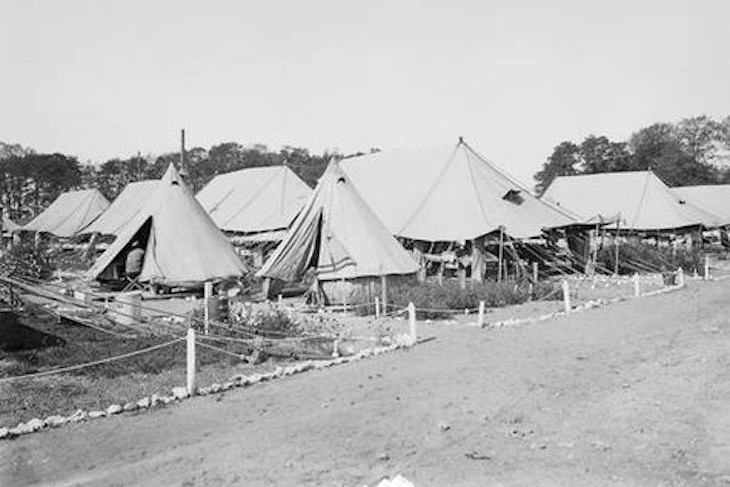
She spent almost 10 months at Croydon War Hospital, until June 11 1918, when she left for France with 1st Australian Stationary Hospital.
Vera went to Rouen to join 1st Australian General Hospital.
The 1st Australian General Hospital was based at Rouen from Apri17 l 1916 until Decembe 7 1918.
This hospital admitted 90,298 patients (46,187 sick and 41,111 wounded) at an average of 2913 a month.
In all, 11,488 were examined by the x-ray department.
In March 1919 Vera reported for duty at AIF Headquarters, London, for several weeks before returning to the Australia Nursing Service.
She was then granted paid leave to attend the Royal Sanitary Institute at 90 Buckingham Palace Rd, London, to study sanitation and health.
She received a promotion from staff nurse to sister.
On July 18 1919 Vera boarded Rugia to sail for Australia.
Her position as a staff nurse was terminated on April 3 1920.
Her rank at that time was sister.
Vera settled back into post-war life, living in the St Kilda-Brighton area of Melbourne.
She became an infant welfare nurse and by 1923 she oversaw the St Kilda Baby Health Centre.
Vera continued nursing until her death at her home in Elwood on February 8 1953.
She is buried in Springvale Botanical Cemetery in Melaleuca Garden M5, Bed 5, Rose 05.
The document below, held at the Australian War Memorial, is an interview conducted with Vera by a Matron Kellet while she was awaiting repatriation.
In her own words, Vera says:
I embarked on the 5th of May 1917 on the Ulysses.
We had troops and munition workers on board.
I had little duty owing to there being so many sisters and so little sickness on board.
At Durban (South Africa), the Suffolk collided with us.
This delayed our troopship a week while the repairs were completed.
The Durban people were extremely good to the troops and to us while we remained there.
The next port of call was Cape Town where we remained five days waiting for our convoy.
Our next port of call was Sierra Leone, but we did not land.
Eventually we reached Plymouth on the 27th of July.
On the last day of our trip, we sighted a submarine, but fortunately we escaped it.
After leave, I was detailed for duty at the Croydon British Hospital, which was divided into many sections, one being the nerve section.
This was a British hospital staffed by Australian sisters, the combination of which I found work most satisfactory.
Here we worked under particularly good conditions.
The section which I was in was very well equipped.
Food was scarce but that was owing to the great food restrictions.
I remained here until January when I was transferred to the Australian Army Hospital, Harefield, which was an exceptionally large, hutted hospital.
At times, the work was very heavy indeed, as we had all the severe cot cases awaiting hospital ships to Australia.
Here we worked under very fair conditions.
The patients were all happy and there was a fair number of amusements for them in the way of concerts.
I remained here until June, when I was transferred to France to the 1st AGH, Rouen.
Here I found it remarkably interesting.
The work was particularly good, and we were busy with heavy battle casualties.
This hospital was very well equipped.
Our hours off duty varied according to the stress of work.
We had sufficient time off to see the interesting sights in Rouen.
I remained with this unit until I was transferred to England in December.
We took over the British Hospital in Sutton Veny, which was a large camp hospital.
I stayed here until March, and was then transferred to No 3 Australian Army Hospital, Dartford, where I am now awaiting transport to Australia.
With thanks: Sally Bertram, RSL Military History Library. Contact Sally at sj.bertram@hotmail.com or call 0409 351 940.

